| 
Health
Harmony Assistance: Announcing a call
for new Board Members
Read
More |
Find
Out About Our
Workshops |
| |
2012 Project
2010 Projects
2007-2008 Projects
|
| |
|
Tellington
Touch Workshops:
|
|
Health
Harmony Vistas
Bonnie Masi
360.385.5111
email:
gobonbiz@gmail.com |
|
 |
|
Tellington
Touch
Animal
Quality Life Consultant
Tellington Touch Practitioner |
|
T-Touch is a type
of body work comprised of specific circles, lifts, and strokes
done all over every inch of the body. The gentle touches work
on the nerve endings just below the surface of the skin, making
a connection through the brain and nervous system, rather than
through the muscles (as in massage). T-Touch affects behavior,
health and an animal's ability to learn and deepens the bond
between human and animal. It takes them beyond instinct and
teaches them to be more intelligent and able to make choices.
|
 |
|
T-Touch
finds areas in an animal's body that indicate tension, fear
of contact, soreness or discomfort. Specific touches and
movements improve self-image and self-confidence. T-Touch
has been used extensively to speed healing and recovery from
injury and illness in all animals, including humans. Attitude
and behavior also can be positively influenced with the T-Touch.
When
an animal's fears and anxieties are reduced by T-Touch, its
ability to learn increases.
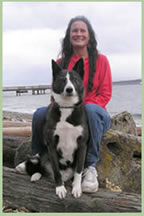
Bernie is the black and white, Karelian bear dog, pictured with Bonnie at the top of this page. He came to live with Bonnie, via her brother Chad, in October 1999 |
T-Touch
Philosophy:
-
To
honor the role of animals in our lives.
-
To
encourage harmony, cooperation and trust between humans
and animals.
-
To
recognize the individual learning process of every human
and animal.
-
To
respect the animal as an individual.
-
To
teach interspecies communication through the T-Touch.
-
To
work with animals using understanding in place of dominance.
|
Tellington Touch Dog clinics |
|
| Host a group dog clinic in your
area and learn
the gentle way to work with your dog on fears, aggression,
biting/mouthing, leash-pulling, jumping, pain over-exuberance,
socialization issues, separation anxiety, arthritis, nervousness
and basic commands. Single
clinic date, 9 a.m. - 12 p.m.- $75 per person, group rate
based on at least 6 people attending.
|
|
|
|
back
to top |
TTEAM
(Tellington Touch Equine Awareness Method)
TTEAM has been used successfully
on horses with:
» Sore backs »Stiffness »Stress »Nervousness »Tension »Trailering
Issues »Inconsistent performance »Lameness »Unevenness
of stride »Cinchiness »Resistance to
vet and ferrier »Bucking and rearing »Clipping,
pulling manes, giving shots »Head tossing »Tail
wringing »Biting »Kicking »Pulling
back when tied »Resistance to grooming or saddling »Stubbornness
or laziness
TTACT
(Tellington Touch Animal Companion Training)
Dogs,
cats, birds, llamas, rabbits, gerbils, ferrets, reptiles,
zoo animals and wildlife have
received the benefits of T-Touch. TTACT offers ways of
work with:
» Timid and aggressive dogs and cat » Fear biters »Separation
anxiety »Gait
irregularities »Illness »Inappropriate
jumping »Licking,
scratching, or barking »Fear of veterinarian or groomer »Improving
performance in show ring and agility »Car sickness »Injury »Arthritis »Dysplasia »Aging »reducing
stress »animals in zoos and in wildlife rehab. Centers »shelter
animals to increase adoptibility »service, therapy,
guide dogs Background:
Physical therapist since 1975, massage therapist since 1988,
training in T-Touch both as practitioner and teacher since
1994. Besides working in the US, I have assisted teaching dog
and horse clinics in England and Africa.
I have
always "talked to animals" and used this
rapport, as well as my extensive skills in the healthcare fields,
in my animal consultations. I address both physical and behavioral
issues and offer references and solutions for diet, homeopathy
and holistic methods. I help you understand your animal's own
language.
I'm available for one-hour private sessions, phone consultations,
group clinics, and demonstrations for private organizations.
|
| back
to top |
Bonnie’s TTouch
Tidbit is about earwork to reduce, prevent and resolve shock
and stress.
Similar
to humans, animals’ ears hold the acupuncture
points for the whole body. If you gently stroke (hold the ear
between your thumb and index finger) from the base of the ear
to the tip and cover all parts of the ear, you’ll start
to calm an animal down. The very tip of the ear is considered
the shock point so make sure to include this. There have been
many incidents recorded of preventing death, while waiting for
or transporting an animal to the veterinarian, by doing earwork.
It also helps an animal recover more quickly from anesthesia
following surgery. At the base of the ear where it attaches to
the head are points for digestion, respiration and reproduction.
By doing circles (move the skin in a clockwise circle and a quarter
starting at 6:00, ending at 9:00) in this area you can calm breathing,
sooth digestion problems (especially horses with colic) and assist
healthy function of these systems. For those that don’t
have ears (birds, iguanas), you can use your pinkie to do small
circles around their ear hole to reduce shock and stress. Quite
often, it’s not because of a head injury that a bird dies
after flying into a window but due to shock and heart attack.
Doing touches on the ear holes have resulted in the bird quickly
recovering and flying away! When iguanas don’t feel well,
they tend to look more pale and gray in color, often due to a
lag in digestion. By working around the ear hole area, you can
assist in promoting digestion and will start to see a change
in color, becoming much more vibrant.
|
| back
to top |
Bonnie
and Bernie’s protocol
for Kennel Cough
In
spring of 2006, Bernie contracted kennel cough. He’d
had it several years prior and was given antibiotics that
helped clear it fairly quickly. Bernie’s vet advised
this time that the current strain(s) did not respond to
antibiotics and
that there wasn’t a lot they could do. They did advise
giving Bernie an herbal cough syrup to help with his hacking
cough.
First
I tried making my own syrup from Natural Health for Dogs
and Cats by Dr Pitcairn. I also gave Bernie the
various
vitamins
he recommended. I wasn’t impressed enough with
the results.
Bernie
does take a nutritional supplement, Vitalzym X
(World Nutrition – 800-548-2710; ask for ext
122, Jennifer, and give her my name) daily. This boosts
the
immune system
and reduces
inflammation and has been great for eliminating allergies
for Bernie and me. I upped his normal 2/day dose to
6/day. I also
gave him 2 Enzogenol, an antioxidant, per day.
I did get children’s herbal cough syrup at my local
Co-op and used it as needed when he had coughing
spells. I still wasn’t
getting the results I wanted. What did the magic
is the same product that works for me if I get an upper
respiratory or sinus
infection – Wellness Formula. I gave Bernie
2 tablets 3 times a day. (Dose for me would be 3
tablets
every 3 hours.)
Bernie is 55 pounds. I tried just one tablet and
that didn’t
work. If I am feeling absolutely dreadful with a
cold and start Wellness Formula, in 2-3 days I can’t
even believe I was sick at all – it works that
fast for me. So, that was what I was looking for
in Bernie – a marked improvement in 24
hours – and I got it!
So,
Kennel Cough protocol per Bernie:
- Vitalzym
X to boost the immune system
- Enzo
Pro – Enzogenol, 2
per day, antioxidant
- Wellness
Formula - all the herbs/vitamins to fight needed to fight
infection in one bottle
- Herbal
Cough Syrup for Children – use
a dropper to squirt it down the throat
|
| back
to top |
Do you know about reverse sneezes?
Besides
having trouble with his ear and the tumor in June 2008, Bernie
also had wheezing attacks. Sometimes these happened
when on a walk or if he barked too excitedly and sometimes
when just resting. The vets said they were “reverse
sneezes” and
probably due to allergies. When they happened on walks,
Bernie froze and seemed like he wouldn’t be able
to go any farther, like he was gasping for air. Very scary!
Helena
Bresk recalled that the thing to do is to rub on each side
of the breast bone (sternum); she doesn’t
recall how she knows this, but it sure works well.
One
night, it happened as Bernie was sleeping. Bonnie didn’t
even turn on the light; she slid her fingers along the underside
of Bernie’s neck until she got to the chest and then
rubbed. The wheezes stopped instantly. Then, she did Tellington
Touches
on his ears (nice strokes from the base of the ears to the
tip), as they are very calming, until he fell right back
to sleep.
He has not had a reverse sneeze since.
|
|
Bernie protocol for tumors:
On June 4, 2008 Bernie was diagnosed,
by X-ray, with a large tumor on his spleen. Our vet recommended
surgery but I did not feel that was the best option for Bernie.
I had 2 animal intuitives and a woman that no one knows (*see
story below) confirm my immediate decision. Our holistic
vet, Dr Anna Gardner put together most of the protocol below.
This
protocol is also a lot of what she recommends to fight cancer
as well. We have no way of knowing if Bernie’s tumor
is cancerous without removing it and the spleen. Both vets
feel
that it has good chances of being benign, as the borders
are even.
Besides
my initial instinct of knowing I would not have the surgery
done, I have had lots of other information with
regards to these
surgeries and read about these tumors on the internet since
6/4/08. Several friends that opted to have the surgery lost
their dog
or cat within days or months anyway, including Bernie’s
regular vet (his dog had this a year ago and died 4 months
post-surgery). The surgery is very difficult on the animal
with a difficult
recovery as well. I would never opt to extend my animal’s
life just for my benefit and months would never be enough
for me to put my animal through this kind of procedure. One
friend
is still paying off the $5000 debt and her cat died 2 days
after surgery. It is not that I believe it is never a good
option,
but just my choice for Bernie now.
At the same time Bernie’s
tumor was discovered (he had a very painful day, when he
could hardly walk), he had a very
bad infection in his right ear. An exploratory procedure
at the vets (to see what was causing the infection) caused
the eardrum
to immediately dissolve the moment it was touched and blood
to pour from the ear; that all happened early June. Black “goop” drained
from Bernie’s ear for many weeks and I cleaned it daily.
During that time, it hurt Bernie to open his mouth and chew,
even a piece of banana was too much to handle. If he yawned,
he tilted his head to one side for 2 months, to try and ease
the discomfort in the right ear. Both Bernie’s vets
believe his body is trying to detox the tumor through the
ear and skin.
He has had terrible dandruff for over a year and gets brushed
many times a day. He hates to be brushed but tolerates it.
I tell him how handsome and good he is and feel that I’m
brushing away the tumor, one flake at a time.
*The best story, however, is from Bonnie’s friend, Nancy,
in New York. Nancy has only seen pictures and heard stories
about Bernie. Nancy was taking her dogs to the lake to swim
in Patterson, NY on a really hot day in June. There’s
always a woman sitting meditating along side the path to the
lake. Nancy left her a bottle of water as they went by but
had never spoken to her. On the way back from the lake to the
car, the woman looked up and said, “Bernie doesn’t
want surgery; he doesn’t think it would do the most good”.
She also pointed to Nancy’s Golden Retriever, Hannah,
and said, “This one is sending him lots of good energy”.
When Nancy got to her car, she saw a guy who fishes in the
lake and asked if he knew the woman. He said he always sees
her meditating and that she’s never spoken to him but
he heard that she is a faith healer. Did I mention we live
in Washington state?
The Protocol:
Lots of prayers and love
A homemade raw meat-based diet
Vitamin C 500mg 1 tablet, twice a day
Vitamin E 400 i.u. 2/day
Omega 3 Fatty Acids (Fish Oil capsules) 1200mg 3 per day
Ester-C 500mg 1 tablet, twice a day
CoQ10 200mg 1 tablet a day
MSM 1000mg 1 tablet a day
Transfer Factor Plus 2, twice a day (www.Shapefast.com)
Pau D’Arco 1 capsule, twice a day
IP6 3 tablets once a day without food (www.physicianformulas.com)
K-9 Complete multivitamin 1½ T per day (www.k9power.com)
Essiac Tea (powder, make tea) ½ Tablespoon twice a
day with food
Noni Juice ½ Tablespoon twice a day with food
Slippery Elm tea (powder, make tea) ½ Tablespoon twice
a day with food
Self Heal Flower Essence 2 droppers full in water bowl 800-548-0075
Pink Yarrow Flower Essence 2 droppers full in water bowl
Modified Protocol starting 2009, after consult with Dennis Wilcox, DVM, in Port Angeles WA
Red Flower – 1 tablet per day
Minor Bupleurum – 1 per day
Wei Chi Booster 3-4 per day
Stasis Breaker 3-4 per day
Vitamin E 400 i.u. 2/day
Omega 3 Fatty Acids (Fish Oil capsules) 1200mg 1 per day
CoQ10 200mg 1 capsule a day
Pau D'Arco 1 capsule a day
IP6 3 tablets once a day without food (www.physicianformulas.com)
Vitalzym X – 2 capsules a day
The next 3 are good for homemade diets and health in general.
K-9 Complete multivitamin 1½ T per day (www.k9power.com)
1 ½ Tablespoons coconut oil mixed into food once a day
1 teaspoon ground green pumpkin seeds mixed into food once a day
------------------------------------------------------------------------------------------------------------------------------------
Goldenseal capsules 1 capsule, twice a day
Red Flower Formula 1 tablet, 2 times per day East Tao Chinese
Herb
Congaplex 1 capsule, twice a day Standard Process, Inc.
Immunplex 1 capsule, twice a day Standard Process, Inc.
Echinacea capsules 400mg 1 capsule, twice a day
Dandelion 540mg 1 capsule, twice a day
Milk Thistle 600mg 1 capsule, twice a day
Everything
above the dotted line, Bernie gets daily. Of the 2 groups
below the dotted line, I alternate between the top
3 and bottom 4, doing just one set a day. This seems to work
best for Bernie, even though Anna’s instructions were
to give him all every day, but that upset his stomach. If he
does vomit his pills up, I give him a break for a day and then
resume the regimen.
Helena
Bresk’s custom homeopathies 805-459-6387, as
directed by her
Notes:
I snip and put the oil capsules (C, E and Fish Oil) into his
morning food dish every day.
He gets the liquids (Noni, Essiac, and Slippery Elm) in his
morning and evening food dishes every day.
He gets the K9 Complete herbal dry mix in his evening food
bowl.
I put all the capsules and tablets down his throat.
Contact Dr Anna Gardner, holistic vet, for specifics for your
animal, wwwpetsynergy.com, 360-796-3749
Bernie’s
Ear Drops
Halo Drops put ½ dropper of each Halo and Silver in
Bernie’s ear once a day until ear is clear
Colloidal Silver
Zymox – once or twice a week; started this in 2010
|
Upset Stomach Solutions – Bernie’s choice
If Bernie started throwing up, the first mix we used was plain yogurt with some honey and coconut oil mixed in.
By 2010, he threw the yogurt mix up. I thought about what all my elderly patients ate when their stomachs were “off” – oatmeal.
The Bernie miracle mix is:
Cook 1 cup of oatmeal in 2 cups of water at least 20-25 minutes, until very well cooked and loose in the pan. Add more water if it is too thick. Mix in 1-2 tablespoons of coconut oil (it is a natural anti-viral and anti-bacterial). Beat 2 eggs and stir that into the hot oatmeal mix. This made 2 meals for Bernie. Usually after 1 day on this oatmeal mix, he was fine. The eggs give them a bit of protein.
This would probably work fine with barley or quinoa as well. Bernie’s sitter, Paula, was amazed at how well this works and how much the dogs seem to like it.
|
Animal Intuitives
Laura Stinchfield www.petpsychic.com 805-895-5968
Susan Azar ptigris@whidbey.com 360-730-1140
Bernie’s tumor got the better of him on 4/25/11 and I lost my wonderful friend and helper of many dogs, cats and people. He would’ve been 14 on 8/4/11.
|
| back
to top |
Animal Stories
(If
anyone has special animal stories to share, please write in!)
Fall
of 2003, I was asked to intuitively meet 3 cats on Whidbey
Island. The older owners just wanted to have more information
on each of their cats in
order to take the best care of them possible. One of these cats was a chocolate
Siamese, Atlas. What Atlas showed me initially was that he loved both the
husband and wife, but was more bonded to the husband. He felt life would
be perfect if he was the only cat, but that he tolerated the other two. As
long as other cats, in the home and neighborhood, recognize him for whom
he is he will no longer initiate any fights unless provoked. He showed me
a lifetime in Egypt as a temple cat, sitting way up on the top of a temple.
He looked down at everyone and felt he was an integral power in the ruling
class during that time. He does roam beyond his own yard and considers all
the neighboring property his kingdom. Atlas is about nine years old and resents
his previous owners for not recognizing him for the handsome and powerful
being he is. (When they visit his current home, he wants nothing to do with
them.)
The
youngest rescue cat they have is a small female, Maybelle,
now 2 years
old. Her mother was killed and she was adopted
at 6 weeks old. The veterinarian reported that he felt she
had been physically abused as she already showed spinal damage
at 6 weeks of age. She does not like to be touched beyond the
top of her head and is an indoor cat for her own protection.
I gave the owners lots of Tellington Touch info to help with
her physical and fear issues. Just during the 2-hour session,
the wife was able to start touching her beyond the head and
she kept coming back for more. She wonders why she can’t
go out with the two male cats. I suggested that they enhance
her indoor environment with pots of grasses and spend extra
time playing with her, besides occasional catnip.
Their
oldest cat (12-13 years) is Baxter. Baxter considers himself
to
be the caretaker of everyone. I picked up that he’d
been with Maybelle before and helped nurture her when she first
came into this household (owners concurred this was so). Baxter
is a large Maine Coon/Manx and very sweet in disposition. He
does worry about everyone else and is most concerned when the
owners go away for a few days or week. He worries that they
may be ill and he won’t be there to take care of them.
He tends to stay outdoors more and doesn’t eat as well
when they’re away, even with daily caregivers coming
in. I advised the owners to send Baxter lots of thought pictures
about where they are going and when they’ll return and
how well they are. All 3 cats need to know about that kind
of thing. I also suggested that they have the caregivers give
treats, catnip and Tellington Touches to make it more of a
positive experience for all 3 cats.
|
| |
|
back
to top |
EP
and the Crow
EP was a 19 lb. black cat, companion to Bonnie’s brother,
Chad. EP was due to be relocated to Chad’s new home (after
living with Bonnie for 8 months). EP wasn’t excited about
the car ride and managed to escape before the door closed… Bonnie
grabbed a bag of EP’s favorite treats to go in search.
Just then she heard a crow squawking at her. It flew next door
and seemed to beckon in that direction. Sure enough, Bonnie followed
the crow and back behind the neighbor’s car was EP! Bonnie
lured him out with the treats and quickly deposited him securely
in Chad’s car. The crow flew above for the whole process
adding his verbal input. As Bonnie walked to her back door,
she thanked the crow and, with two final squawks, away it
flew. Watch
for any animals that come across your path and invite them
to share a journey with you! Please send in any of your animal
connection
stories for our next issue!!
|
| |
|
back
to top |
My
own dog is Bernie. Bernie is a Karelian (Russian bear dog)
now 6 years old. My brother rescued Bernie in AK when he
was 1½ years old. I have lots of Bernie stories but
this one is about Bernie at Christmas. Bernie knows about
presents. When it’s someone’s birthday, Bernie
waits to see when he gets a package to open, not that he
will… At Christmas time 2 years ago, I wrapped Bernie’s
new frog toy and put it at the very back of the tree with
all the other presents heaped in front of it. Bernie did
not see this toy and it was mail ordered so hadn’t
even been in my car from a local pet shop. I came into my
living room a few hours later and Bernie was reaching to
the back of the tree to pull that one package out; he did
not touch any others. I had to put the gift in my closet
and tell him how many days he had to wait to open his Christmas
gift. He was more than ready when the time came and waited
and watched for me to give him “froggy”. Bernie
still has his very first toy. He treasures each one and the
only ones he’s pulled apart at all are the kind you
stuff treats into and have to pull Velcro apart to get to
the treats. Bernie discovered by removing the Velcro, it
is much easier, or by biting a small hole directly into the
pocket.
Bernie’s
first year at my house, we worked on some basic training.
At this point, Bernie prefers Tellington Touches to looking
out the car window most of the time. He loves T-Touches any
time and will sit patiently as long as someone is willing
to provide.
To
work on leading exercises and street smarts, I would take
Bernie and a neighbor dog friend, Cree, on 2-hour run/walks
4-5 times a week. When we were picking up Cree, I’d
grab a purple leash for him. When I was just doing short
errands in town with Bernie, I would just take Bernie’s
blue/green lead. On days when I couldn’t take the time
for any walks, Bernie would bring me the purple leash, as
I’d be working at the computer. He knew the purple
leash meant the long best walk. I’d tell Bernie I just
couldn’t do the walk that day. He’d wait a couple
hours and then try again, always with the purple leash – ever
hopeful.
If
anyone has special animal stories to share, please write
in! |
| back
to top |
NPR
Commentator Daniel Pinkwater has some great dog stories.
Here are links to a couple of them:
Dog
or Wolf? Commentator
Daniel Pinkwater tells about a dog named Lulu, whose
character is shaped entirely by one key part of her
make-up: she is more wolf than dog. She understands
everything her masters say, but feels no need to obey.
Fat
Dogs While listening to this program, commentator
Daniel Pinkwater was startled by the news that American
cats and dogs are too fat. He has a conversation with
his dog Lulu about the situation.
Learn
more about Daniel Pinkwater
|
| |
|
back
to top |
|
|
|